Is Bacalar Lagoon Still Seven Colors In 2026?
The 2020 browning episode, the recovery researchers report, and what today's water-quality data and visitors say about Bacalar Lagoon's famous seven colors.
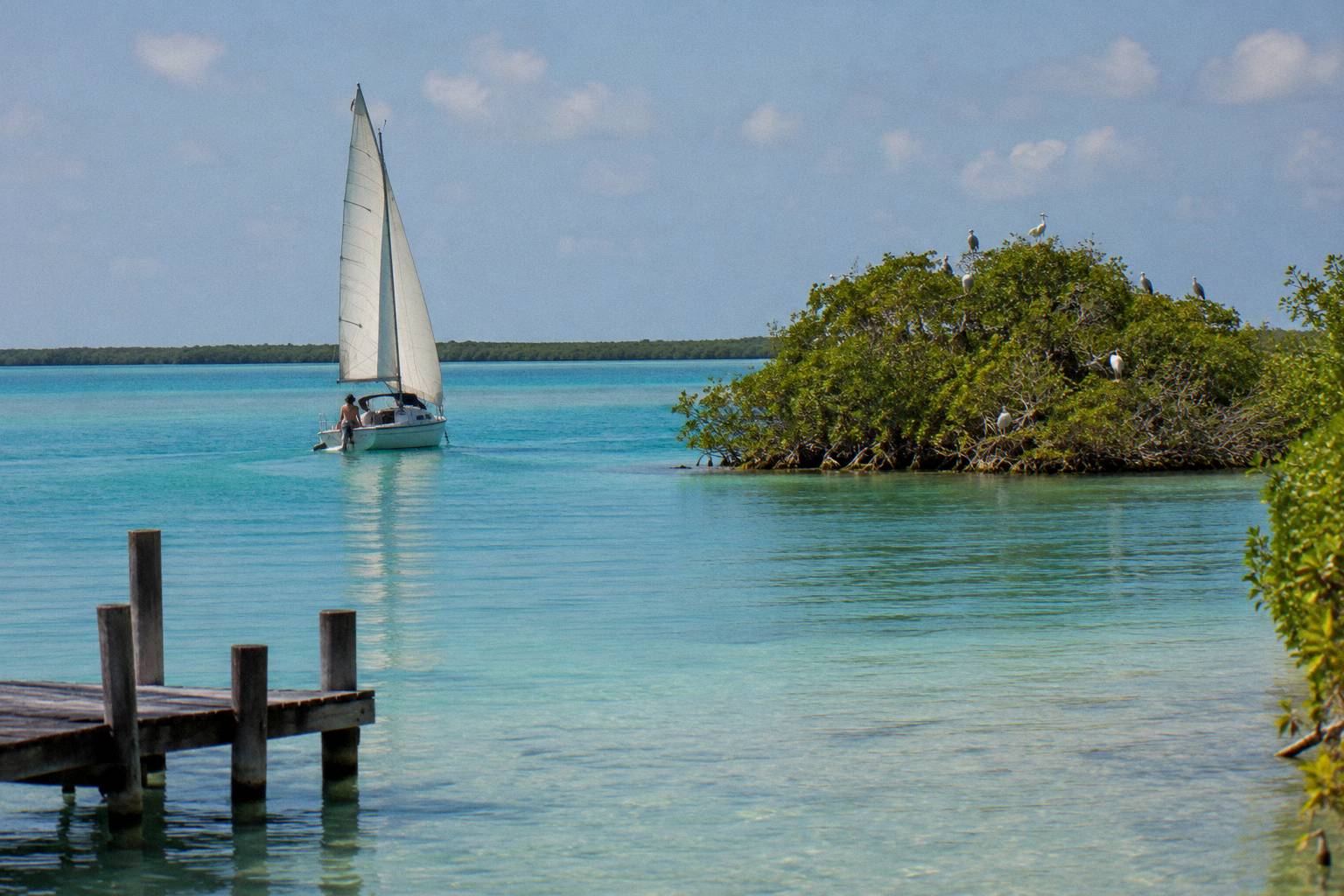
Bacalar Lagoon earned its nickname: on a calm, clear morning the water shifts through distinct bands of turquoise, teal, jade and deep blue, the effect of a shallow sandy floor dropping suddenly into old cenote basins. Then 2020 happened. A heavy-rain year pushed nutrients into the lagoon and the water turned brown in places, and a wave of travel posts asked whether the seven colors were gone for good. Six years on, the question still gets typed into search bars, usually right before someone books a trip. The short answer involves chemistry, wind and timing, and our guide to why Bacalar's water shifts from jade to deep blue explains where each shade sits and which boat or sail tour reaches the brightest stretches.
Yes, in the sense that matters to a visitor: the research and the recent reporting describe a lagoon that recovered from its 2020 brownification episode and still shows its famous color bands, while carrying real, ongoing pressure from construction and nutrient inputs. Nothing guarantees the color on any given day, and nothing should. The bands depend on light, wind and rainfall, so two visits a week apart can look different. What the record supports is that the 2020 browning was a short-term event tied to intense rainfall and nutrient runoff, that the water cleared in the years after, and that monitoring through 2024 still classifies the central and southern lagoon as oligotrophic, meaning low in nutrients, the condition that keeps the water transparent and blue. None of that promises a postcard. It explains why most mornings still produce one. If that blue tempts you to get in, our guide to swimming safety in Bacalar Lagoon walks through the water quality data, crocodile sightings and dengue alerts so you can make your own call.
The answer has three parts, and this article works through each in turn. First, the 2020 event itself: what a peer-reviewed water-quality study published in late 2025 says actually happened, and why researchers describe it as short-term. Second, the current state: what the same study found when it classified the lagoon's three basins, and where the weak spots are. Third, what a visitor in 2026 actually sees, and what visitors themselves control, because the sunscreen rules and the stromatolite protections exist precisely to keep the colors from fading a second time.
What Actually Happened To The Colors In 2020?
In 2020 the lagoon experienced what researchers call a short-term brownification event: intense rainfall and increased nutrient inputs clouded the water of a normally low-nutrient lake, and the color bands faded in the affected areas. The same peer-reviewed study that documented the event describes it as temporary, and subsequent reporting and research describe recovery by roughly 2022. The phrase to hold onto is "short-term." This was not a permanent ecological shift, it was a nutrient pulse during an unusually wet period, and the lagoon's own chemistry pulled it back.
The study in question, published in MDPI Hydrology in December 2025 under the title "Trends in Surface Water Quality and Trophic State in the Yucatan Peninsula over the Last Decade," documents the 2020 brownification directly. Its authors note that Lake Bacalar is normally oligotrophic, meaning nutrient-poor and transparent, and that the 2020 event was "related to intense rainfall and increased nutrient inputs." That matters because it identifies the mechanism: nutrients wash in, algae respond, transparency drops, and the blue tones go green-brown. Remove the nutrient pulse and the mechanism reverses, which is what monitoring in the years after describes.
Why bring up a six-year-old episode at all? Because it is the single most useful data point the lagoon has about its own resilience. The brownification happened, it was measured, and it reversed. It also left a warning label. The same nutrient pathway that caused it has not gone away: the study found higher nutrient input in the northern basin than in the lagoon's other reaches. The 2020 event is best read as proof the colors can recover, attached to a reminder that they can also be stressed again.
What Does The Current Water-Quality Research Say?
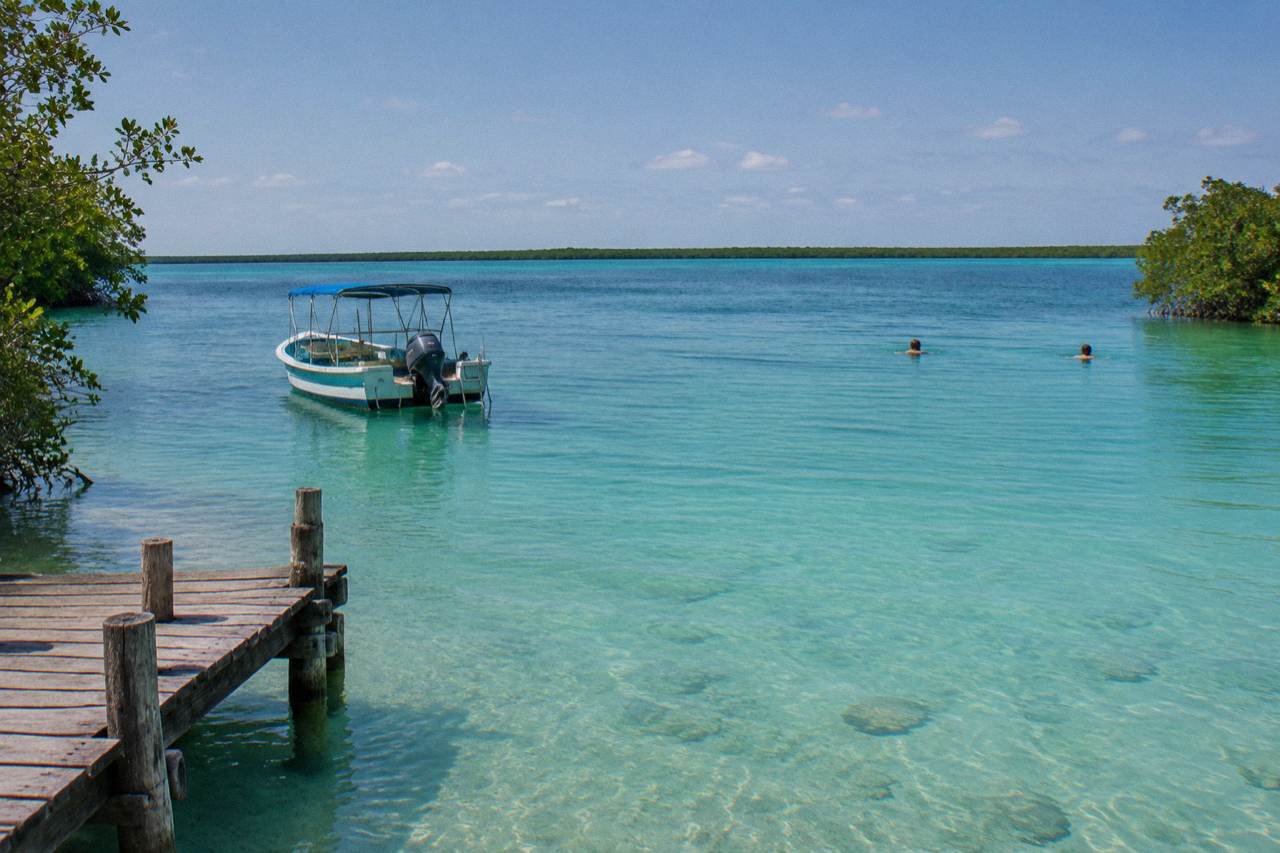
The December 2025 study splits the lagoon into three basins and finds Bacalar Centro and Bacalar Sur oligotrophic, while Bacalar Norte is mesotrophic, indicating higher nutrient input in the north. On the study's wider water-quality index, Bacalar Centro shows fair quality, a middling grade rather than a crisis or a clean bill. In plain language: the middle and south of the lagoon, where most tours swim, remain nutrient-poor and clear, and the north end carries a heavier load from development.
| Basin | Trophic classification | What it means for the water |
|---|---|---|
| Bacalar Norte | Mesotrophic | Moderate nutrient levels, indicating higher nutrient input, the basin under most development pressure |
| Bacalar Centro | Oligotrophic | Low nutrients, transparent water, fair quality on the study's water-quality index |
| Bacalar Sur | Oligotrophic | Low nutrients, transparent water, the basin nearest Los Rapidos and Xul-Ha |
The trophic grades come from sampling data, not from a daily color forecast, and the study covers the Yucatan Peninsula's lakes broadly, so Bacalar is one lake among many in its index. And oligotrophic does not mean untouched: the same paper flags an increasing eutrophication trend across the region, which is the direction that produced the 2020 event. The lagoon's famous stromatolites, strictly microbialites as the researcher Maria Luisa Villarreal explained in February 2026, remain present and locally resilient, though Villarreal is blunt that their water-cleaning effect is limited to their immediate surroundings and is no substitute for keeping nutrients out in the first place. For more on these living structures, see the guide to Bacalar's stromatolites and the rules.
None of this is a reason to stay home. It is a reason to understand what you are looking at. A lagoon roughly 40 to 60 km long depending on how it is measured, the second largest freshwater lake in Mexico, will not be uniform, and the grades above explain why some corners look pristine while others carry murkier water after rain.
What Do Visitors Actually See Today?
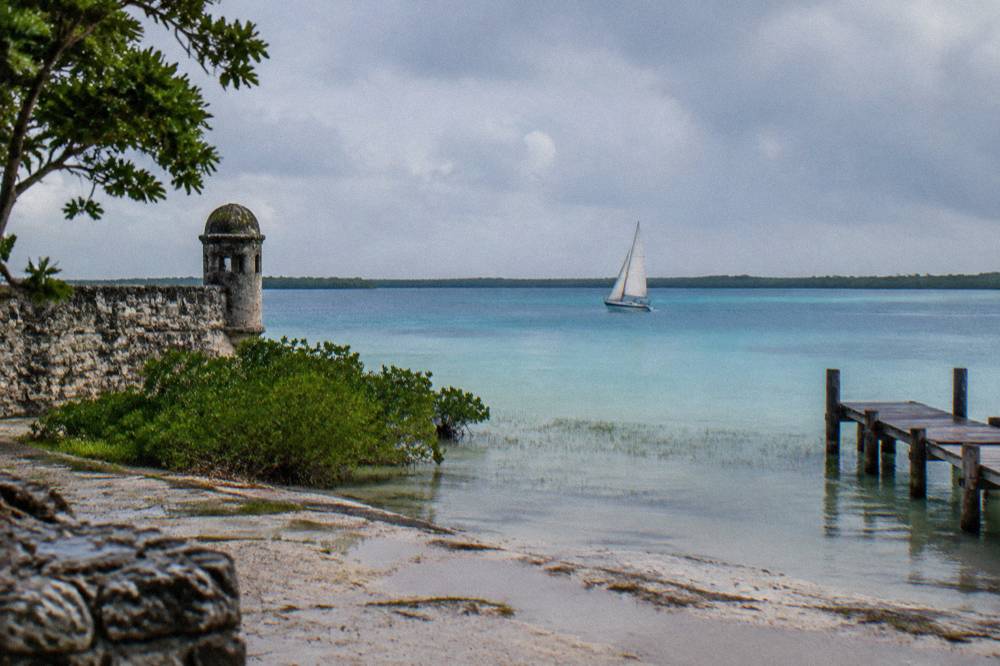
Recent reporting and guest reviews describe the color bands as intact and variable: strong on calm, clear mornings, softer after heavy rain or wind, with the lagoon protected at both state and federal level, and visitor rules now in place that shape how every tour uses the water. The bands are an optical effect of sand, depth and light rather than a fixed feature, so they read differently every single day. The seven colors were never a permanent installation. They are an optical result of white sand, varying depth and the sudden walls of the old cenotes, and they read differently depending on the sun's angle, the wind and the amount of recent rain. The rainy months of June through September or October bring heavy afternoon rains that can cloud the water temporarily, while the dry months of November to April are when most visitors report the brightest bands.
That variability is exactly why locals and operators keep repeating the same advice: go in the morning. Sunrise and the hours just after are when the wind is lowest and the light rakes across the shallows at the angle that makes the bands pop. The listing for the Sunrise Paddleboard Tour in Bacalar Lagoon, from $36 per person and rated 4.9 across 654 reviews, is built entirely around that window. Later in the day, wind chop scatters the light and the bands flatten. That is not pollution, it is optics.
The 2026 reporting reviewed for this article found no widespread color-loss event, no confirmed die-off of the microbialites, and no swimming bans tied to water quality in the lagoon itself. What it did find is pressure: construction and nutrient concerns around the north basin, an October 2026 rain episode that flooded parts of town, and researchers urging focus on sedimentation. Those are real. But a traveler standing on a dock at 7 a.m. in the dry season is, by every account that exists, still looking at one of the most distinctive bodies of freshwater on the planet.
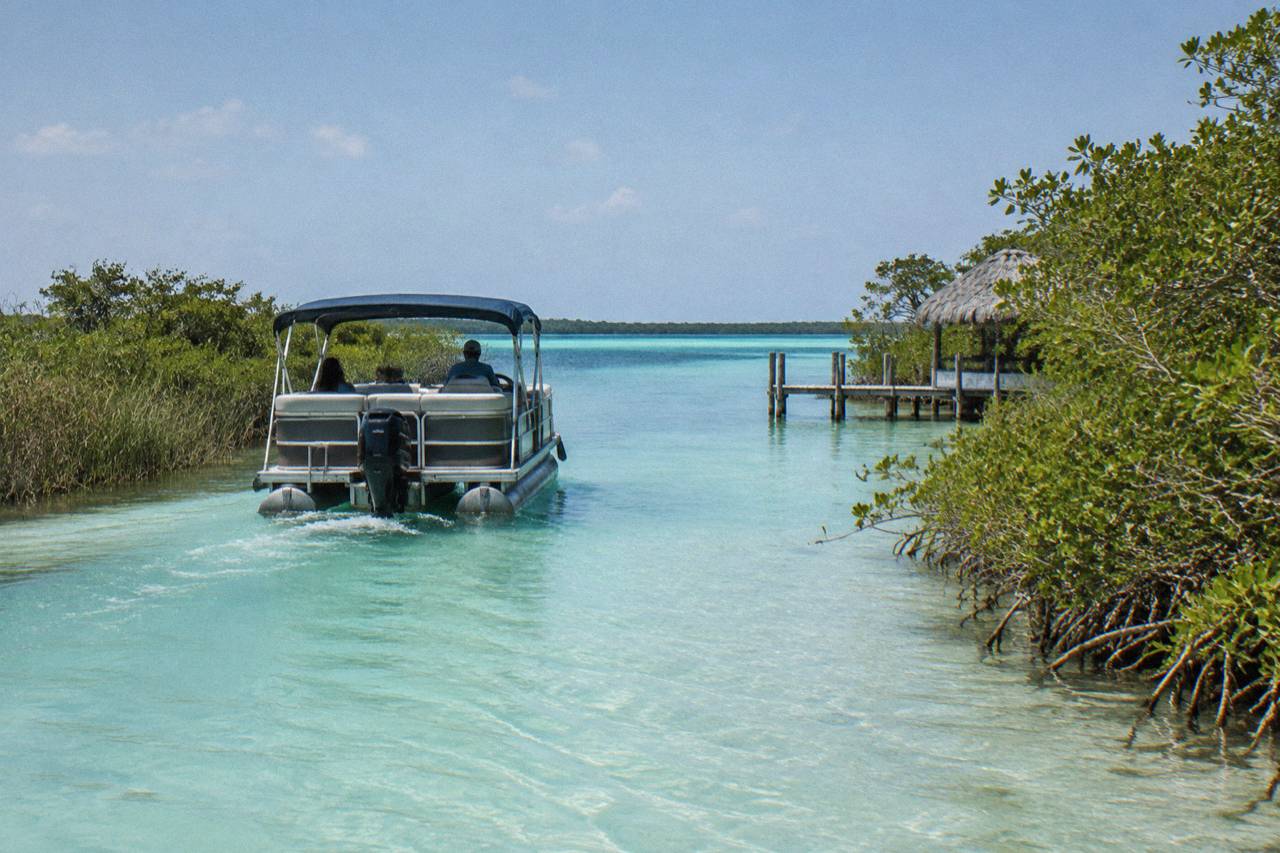
If you want the widest view of the color gradient in one sitting, a boat or sailboat crossing remains the best format. The Pontoon Tour covering the Pirate Channel, cenotes and islands runs 2 hours 30 minutes, from $32 per person, rated 4.9 across 432 reviews, and crosses from the shallows out over the deep basins where the blue turns almost navy. Visit Bacalar Lagoon covers the full range of formats, from paddles to sails, in its tour guides.
Pontoon, Pirate Channel And Cenotes
2 hours 30 minutes
★ 4.9 · 432 reviews · From $32
Check availability →What Do The Rules Have To Do With The Colors?
Quite a lot: the municipal ecology directorate bans sunscreen in the lagoon, even biodegradable sunscreen, because it feeds the eutrophication that changes the water's color, and it protects the microbialites with a look-but-do-not-touch rule enforced at a minimum distance of 3 meters. These are not bureaucratic niceties. They are the direct, visitor-facing countermeasures to the exact mechanism that caused the 2020 browning.
The municipal ecology guide is unusually specific. Its wording on sunscreen: do not use it to swim in the lagoon, "even if it is biodegradable because it provides nutrients that accelerate eutrophication, one of the causes of changing colors." Every swimmer wearing sunscreen is a small nutrient input, multiplied by thousands of swimmers a year. The same guide bars touching, climbing on, sitting on or anchoring boats on the stromatolites, which must be viewed from at least 3 meters, and the port authority marks sensitive microbialite zones with buoys that are off-limits to both vessels and swimmers. Also on the forbidden list: exfoliating with the lagoon's clay, touching the Chivita snail, smoking, waste, and tying up to mangroves. One operator, Laska Sailing Tours, prints the sunscreen prohibition directly on its own listing, a sign the rule has moved from guidance to expectation.
The practical translation for a visitor is simple. Wear UV clothing instead of sunscreen for swimming, keep 3 meters off anything that looks like a lumpy rock, respect every buoyed zone, and choose operators who state these rules themselves. The lagoon's colors survived 2020 because the nutrient pulse stopped. Whether they survive the next decade depends on whether the inputs stay low, and visitor behavior is one of the inputs operators can actually control on the water. In that sense the seven colors are not just a sight to photograph, they are something every visitor helps maintain or erode, one swim at a time.
When Are The Colors At Their Best?
The dry months of November to April bring the clearest water and the brightest bands, with May and October as quieter shoulder months, and mornings beat afternoons on any day of the year. Bacalar runs tours all year round; the seasons change comfort and color intensity, not whether the lagoon is open. That last clause matters because a surprising amount of travel copy implies the lagoon has a closed season. It does not. It has a rainy season, June to September or October, with heavy afternoon rains and a chance of temporary clouding, and a hurricane window through late November that in 2026 brought rain and local flooding to Bacalar without a named storm landfall on the town. Temperature is the other seasonal question travelers ask, and the guide to Bacalar Lagoon's year round water temperature explains why it rarely changes which tour you book.
| Period | Typical conditions | What it means for the colors |
|---|---|---|
| November to April | Dry season, lower rain, calmer mornings | Clearest water, brightest bands, most visitors |
| May and October | Shoulder months, fewer crowds | Good color with occasional rain influence |
| June to September | Rainy season, heavy afternoon rains | Bands intact but temporarily clouded after rain |
| Any day, early morning | Lowest wind, low-angle light | The single best time to see the color gradient |
The one calendar quirk worth knowing before you book: in the low season there is no boating on Wednesdays, the day nautical providers use for cleaning work, with regular boating resuming around Holy Week, and a proposal to move the rest day has been reported without a confirmed outcome. The day is currently reported as Wednesday, so check the listing before planning a midweek boat trip. The full picture is in the guide to the best time for a Bacalar Lagoon tour.
Sargassum, the seaweed that has battered the Caribbean coast in record volume in 2026, is not a Bacalar factor: the lagoon is freshwater, and the seaweed problem belongs to the coast at Tulum and Mahahual. That distinction has made Bacalar an even more attractive inland alternative in a year when beach towns are raking sargassum daily. Travelers comparing the two should also weigh crowd levels, which recent travel analyses place firmly in Bacalar's favor relative to Tulum.
Which Tour Format Shows The Colors Best?
A sailing or small-boat crossing shows the gradient best because it travels across depth changes slowly and quietly; a sunrise paddle puts you at water level for the strongest optics of the day; a boat-and-cenotes trip combines the color bands with the deep dark basins that create them. All three formats are represented among the best-established listings on the lagoon, and the right pick depends less on quality than on how you want to move through the water.
| Format | Example listing | Price from | Rating and reviews | Why it suits color viewing |
|---|---|---|---|---|
| Sailing | Sailing Tour through the Laguna de los Siete Colores, 3 hours | $45 per person | 5.0 from 1,670 reviews | Quiet, wind-powered crossing of the gradient, seasonal fruit and beer included |
| Sunrise paddle | Sunrise Paddleboard Tour in Bacalar Lagoon, 3 hours | $36 per person | 4.9 from 654 reviews | Water-level view in the day's calmest, lowest-angle light |
| Boat and cenotes | Bacalar Boat Tour and Visit to Cenotes, 3 hours | $29 per person | 4.9 from 1,321 reviews | Crosses the bands and stops at the cenote basins that produce the depth contrast |
The sailing tour deserves its place at the top of that table for one reason beyond the rating: a sailboat crosses the color bands at the pace the landscape rewards. The listing, operated by Wild Wave Bacalar, departs from the Casa Arabe pier on the Costera, carries a stated maximum of 30 travelers, and includes a seasonal fruit snack, bottled water and beer. The paddle tour, run by Adventure Lab from The Yak Lake House with a maximum of 16, includes coffee, a professional guide, board and lifejacket, and photography, which is a quiet bonus: the operator's photos capture the morning light most travelers fail to. The boat-and-cenotes trip from DayTour Bacalar departs Carmelita Lagoon Club with a bilingual guide, fruit drinks, snacks and 3 beers per adult.
For a deeper comparison, the guide to which Bacalar Lagoon tour to book walks the full decision. If your question is specifically the one in this article's title, any of the three formats will answer it within the first twenty minutes on the water.
The ViveSUP kayak or SUP tour adds something the big formats cannot: a maximum of 4 travelers, a breakfast of Nutella toast and coffee, GoPro pictures, and a meditation component aimed squarely at the still, early hours when the lagoon reads most vividly. Rated 5.0 from 697 reviews and from $53 per person, it is the connoisseur's version of the morning visit.
Common Questions About Bacalar Lagoon In 2026
Why Did Bacalar Lagoon Turn Brown In 2020?
Intense rainfall washed increased nutrients into a normally nutrient-poor lake, clouding the water and fading the color bands in affected areas. A peer-reviewed study published in December 2025 documents the event and describes it as short-term, and the water cleared once the nutrient pulse passed.
Is Sunscreen Really Banned In Bacalar Lagoon?
The municipal ecology directorate's guidance says do not use sunscreen to swim in the lagoon, even biodegradable sunscreen, because it feeds the eutrophication that changes the water's color. UV clothing is the recommended alternative, and some tour operators print the rule directly on their listings.
Can I Touch The Stromatolites?
No. The rules require viewing from at least 3 meters, and touching, climbing, sitting on or anchoring boats on them is forbidden. The structures are actually microbialites in the strict scientific sense, they are alive, and buoyed sensitive zones around them are off-limits to both vessels and swimmers.
When Is The Water Clearest?
Dry-season mornings, November to April, offer the clearest water and brightest bands, and early morning beats afternoon on any day thanks to lower wind and low-angle light. June to September brings afternoon rains that can cloud the water temporarily, but the lagoon never closes; tours run all year.
Does Sargassum Affect Bacalar Lagoon?
No. The lagoon is freshwater, and the record sargassum arrivals of 2026 affect the Caribbean coast at places like Tulum and Mahahual, not Bacalar. This is one reason the lagoon has grown as an inland alternative in seaweed years.