Bacalar Stromatolites: The 3-Meter Rule And What You Can See On A Tour
Bacalar Lagoon's stromatolites, strictly microbialites, are living rock-like formations that survive here because visitors keep a simple promise: look from at least 3 meters, and never touch.
Short answer
Bacalar's stromatolites are microbialites, living formations that grow in the lagoon's mineral-rich water. A municipal ecology guide bans touching, climbing, sitting on or anchoring on them, and asks visitors to stay at least 3 meters back. Buoyed zones are fully off-limits, and most lagoon tours pass them at a distance.
Bacalar Lagoon holds living microbialites, structures built layer by layer by microbes in its shallow water, and most visitors float right past them without knowing what they are looking at. The formations people call stromatolites are, strictly speaking, microbialites, and that distinction matters more here than anywhere else in Mexico, because it shapes the rules every tour on the lagoon has to follow. This guide explains what the formations are, where a tour actually passes them, the 3-meter rule that governs how close anyone may get, and how to pick an operator that respects it. If you're curious why these formations earn such strict protection, what makes Bacalar's living microbialites so rare covers the science behind the rules.
The short version: look, do not touch, and give them at least 3 meters. The municipal ecology directorate puts it bluntly on its visitor guide: they look like rocks, but they are alive. For the fuller picture of the lagoon itself, see Visit Bacalar Lagoon, which covers the seven-color water and how the lagoon is zoned.
What Are The Stromatolites In Bacalar Lagoon?
Stromatolites in Bacalar Lagoon are large, rock-like structures built by microbes, and researchers classify them strictly as microbialites rather than true stromatolites. They grow in the lagoon's calcium-rich freshwater, they are alive, and they form one of the largest known living concentrations of their kind, which is why the municipality protects them with a specific visitor code.
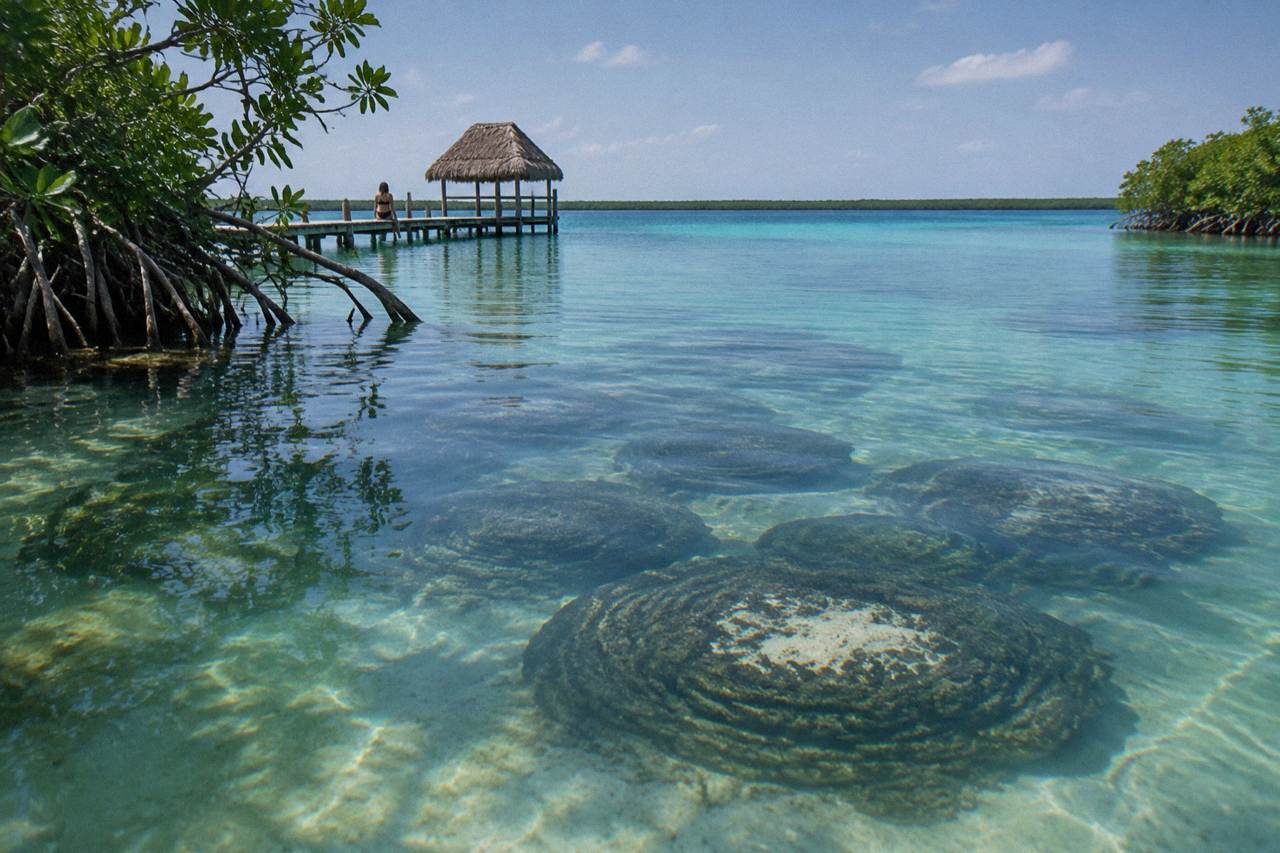
The word most visitors use is stromatolites, and the lagoon's tourism industry uses it too, on signs and tour descriptions alike. The stricter scientific term is microbialites, and researcher Maria Luisa Villarreal made the point publicly in February 2026: Bacalar does not have stromatolites in the strict sense, but rather microbialites. The difference is technical, about the internal structure of the formation, but the practical takeaway is the same either way. These are colonies of microorganisms that trap minerals in the water and build dome-shaped and pillar-shaped structures over years and decades. Microbialite structures cover parts of the lagoon floor, and boat tours pass over some of these living formations.
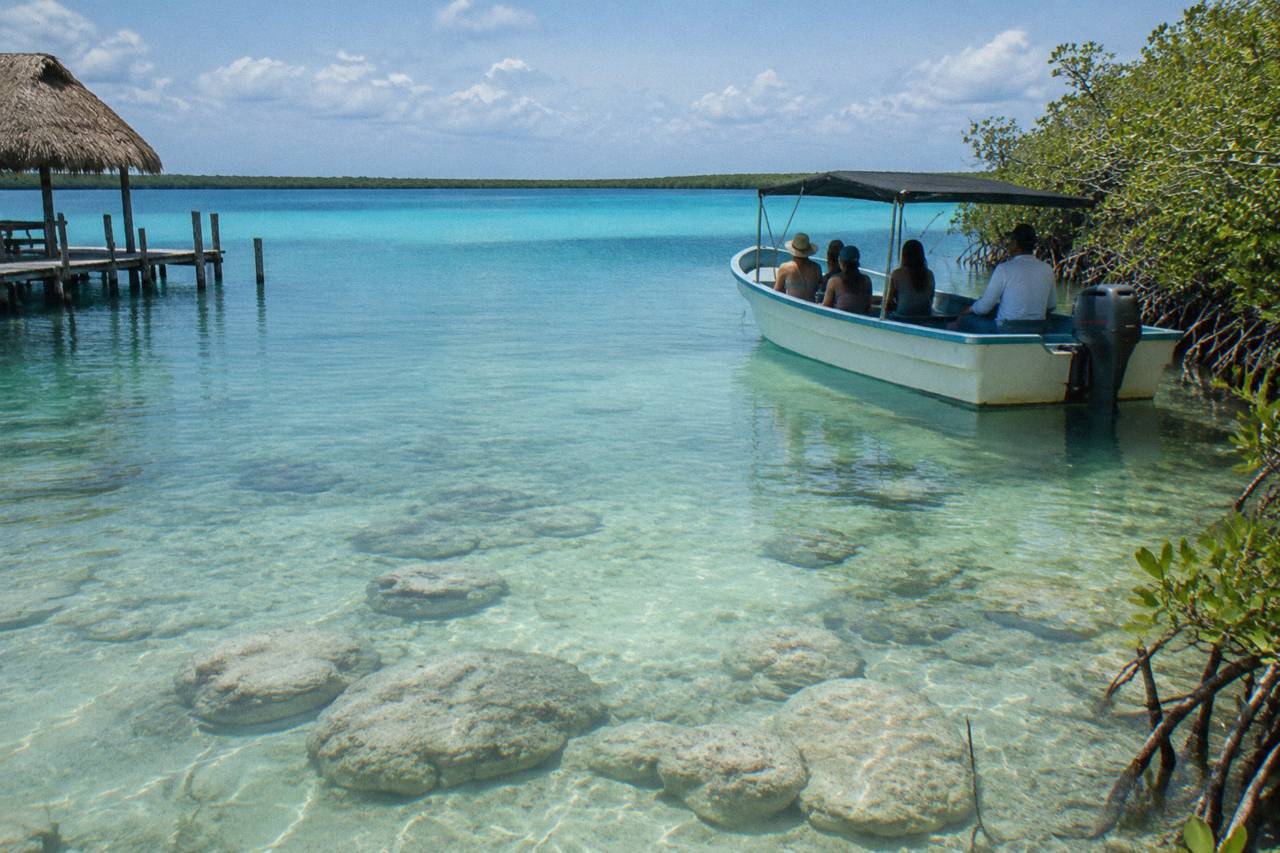
They look like dark, rounded boulders in shallow water, often just below the surface near the shore or around the cenotes that puncture the lagoon bed. That near-invisibility is exactly the risk. A swimmer pushing off what looks like a rock, or a crew anchoring a pontoon on a convenient shelf, can damage a structure that took a very long time to grow.
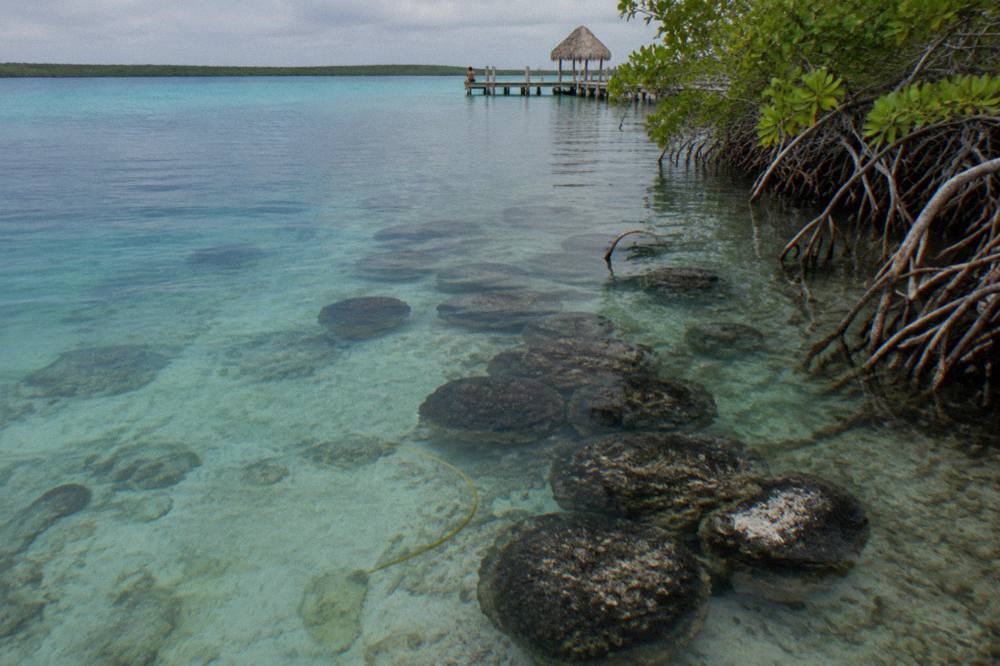
A common claim is that the formations "clean" the lagoon and produce its famous colors. Villarreal's work pushes back on that: their effect on water quality is local and limited to their immediate surroundings, insufficient for a lagoon nearly 60 kilometers long. The colors come from the water's depth, floor and light, not from the microbialites acting as a filter. The formations are remarkable without the exaggeration, and the lagoon's color does not depend on them.
| Question | Answer |
|---|---|
| What are they called locally? | Stromatolites |
| What are they, strictly? | Microbialites |
| Are they alive? | Yes, built by living microbial colonies |
| How big is the coverage? | Reports describe coverage above 70 percent in some areas |
| Do they clean the whole lagoon? | No, their effect is local and limited |
Where Can You See Stromatolites On A Bacalar Tour?
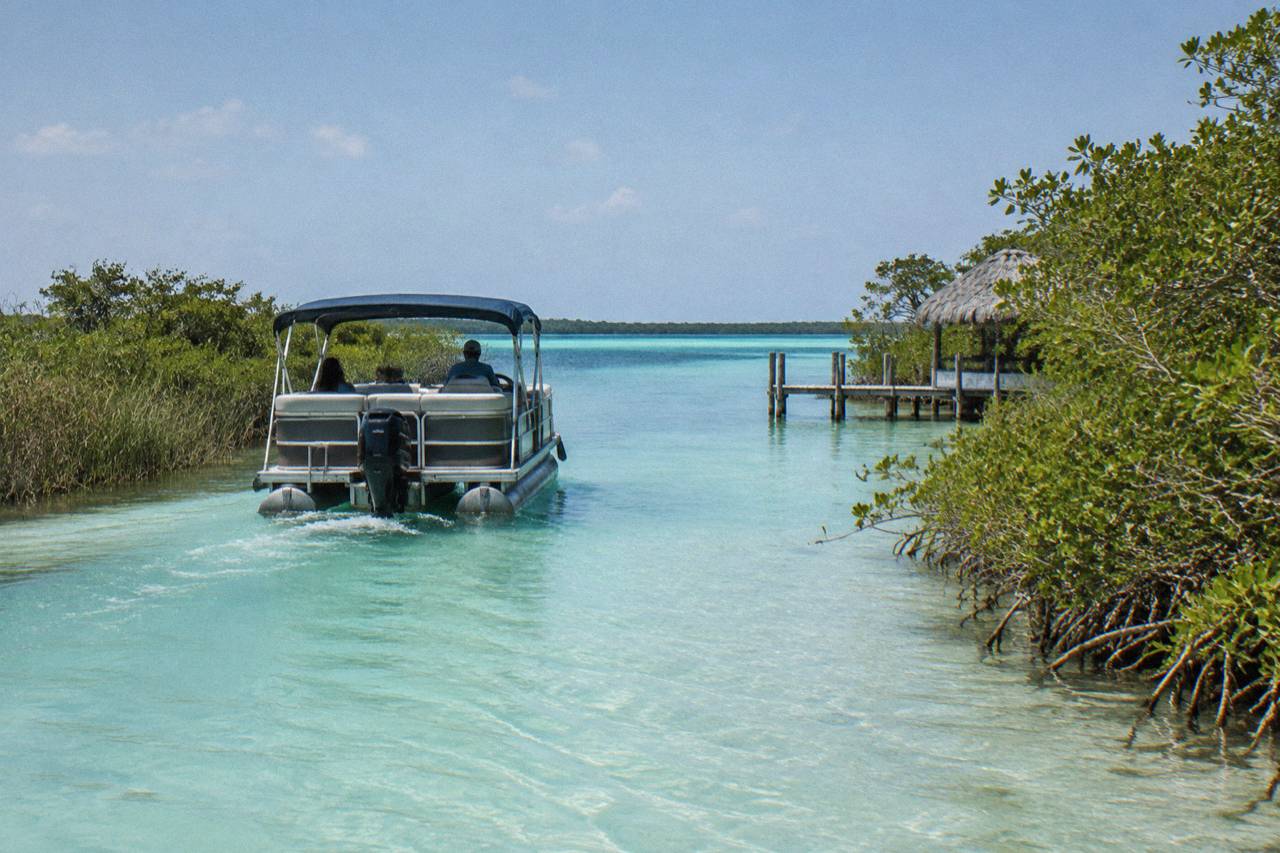
Most lagoon tours pass microbialites near the Canal de los Piratas, around the lagoon's cenotes and along the shallow margins where buoys mark protected zones. Tours do not stop on them, they slow down or hold at a distance, and the best viewing is from a boat or paddleboard in calm, clear morning light, when the dark domes are visible under the surface.
The geography is simple. The lagoon runs roughly 40 to 60 kilometers north to south depending on how it is measured, about 2 kilometers at its widest, and the microbialites cluster in the shallow, mineral-rich areas, particularly around the cenotes such as Cenote Negro and Cenote Esmeralda, and in the channel areas. The Canal de los Piratas is the best-known concentration, which is why nearly every boat route includes it. Our guide to Canal de los Piratas tours and rules covers that channel in detail.
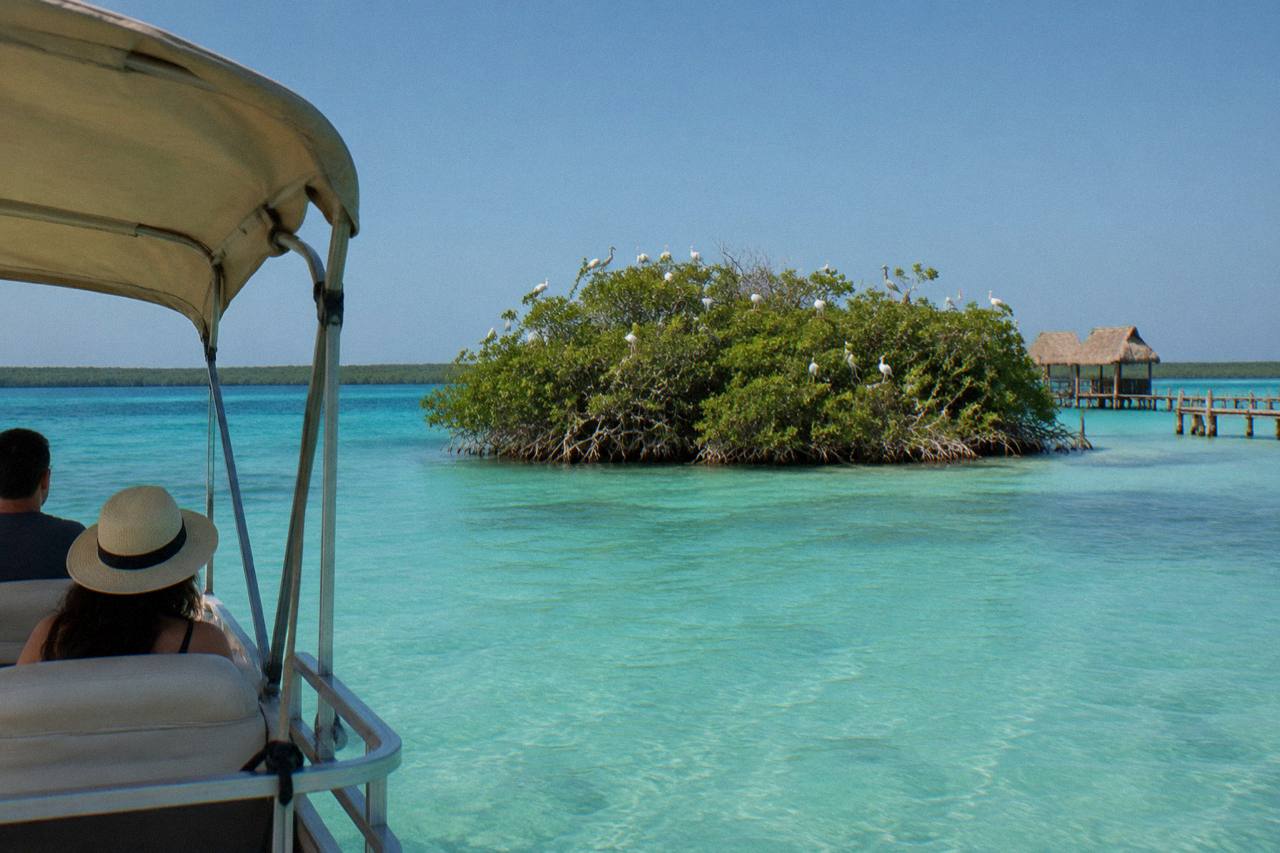
What a tour looks like in practice: a pontoon or sailboat follows the shoreline, the guide points out the dark domes below the surface, and the boat holds position in open water while guests swim away from the buoyed zones. Listings describe these routes in their own words, and the Boat and Cenotes tour by DayTour Bacalar, from $29 per person, 4.9 from 1,321 reviews, is a good example of the format: a 3-hour circuit from Casa China Bacalar with a bilingual guide, fruit drinks and snacks, passing the cenotes where the formations concentrate.
Three formats dominate, and each treats the microbialites differently. A sailing tour moves quietly and draws shallow, which suits the sensitive margins. A pontoon carries more people and stays in deeper water between stops. A paddleboard or kayak at sunrise gets you closest to the water surface itself, silently, which is the most intimate view of the domes short of swimming.
| Tour format | How you see the microbialites | Typical vibe |
|---|---|---|
| Sailboat | Slow pass along the shallows, swim stops in open water | Quiet, low impact |
| Pontoon | Guided circuit past the cenotes and the pirate channel | Social, family friendly |
| SUP or kayak | Glide over the shallows at a distance, dawn light | Small group, silent |
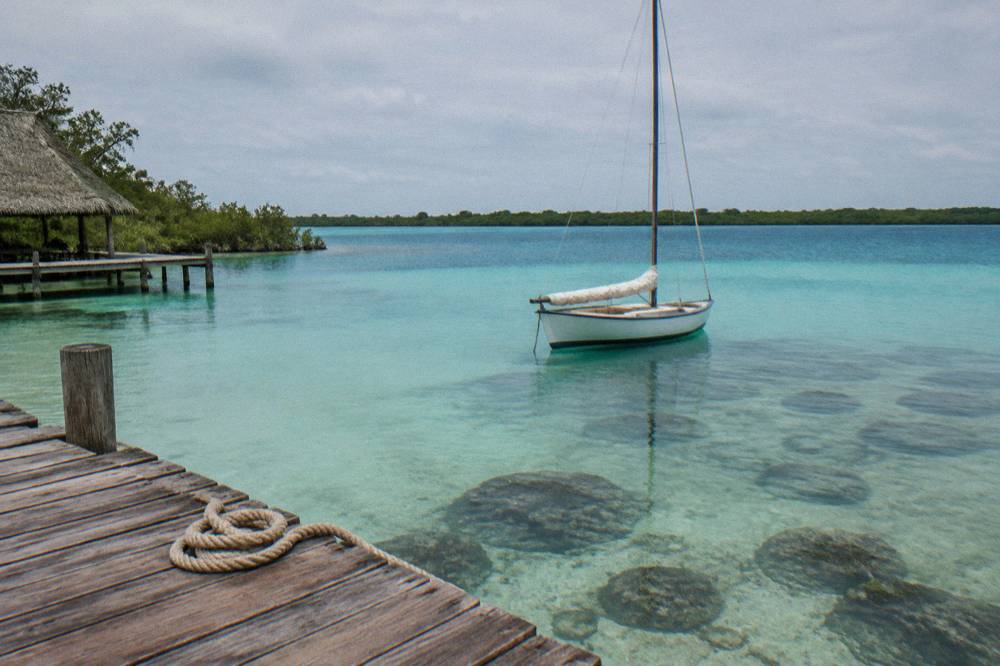
If you want the deeper background on the two flooded cenotes where formations also appear, our Cenote Negro and Cenote Esmeralda guide explains what those deep dark sinks are and how tours approach them.
Why Is There A 3-Meter Rule In Bacalar Lagoon?
The 3-meter rule comes from the municipal ecology directorate's visitor guide, which asks everyone to view the microbialites from at least 3 meters away and never touch, climb, sit on or anchor a boat on them. Buoyed sensitive zones are completely off-limits to vessels and swimmers, and the same guide bans a list of other habits that damage the lagoon's ecology.
The rule exists because the formations are both alive and fragile. Microbes build the structures in thin layers, and a footprint, an anchor or a hand crushing the surface kills the living film that does the building. The directorate's guide, published under the municipal ecological regulations, is direct about it: don't touch or climb or sit on the stromatolites, or anchor or beach any kind of boat on them. They look like rocks, but they are alive. Look at them from a distance of at least 3 meters.
The same guide carries the bans that follow from the same logic. Sunscreen is prohibited for swimming in the lagoon, even biodegradable sunscreen, because it feeds the eutrophication that changes the water's color. Exfoliating with the lagoon's clay is forbidden. So are touching the Chivita snail, smoking, leaving waste, using the lagoon as a toilet and tying up to mangroves. The official guide is published by the Dirección de Ecología del Municipio de Bacalar, and it is worth reading before you swim anywhere on the lagoon, not just at the famous spots.
Can You Swim Near Stromatolites At Los Rapidos?
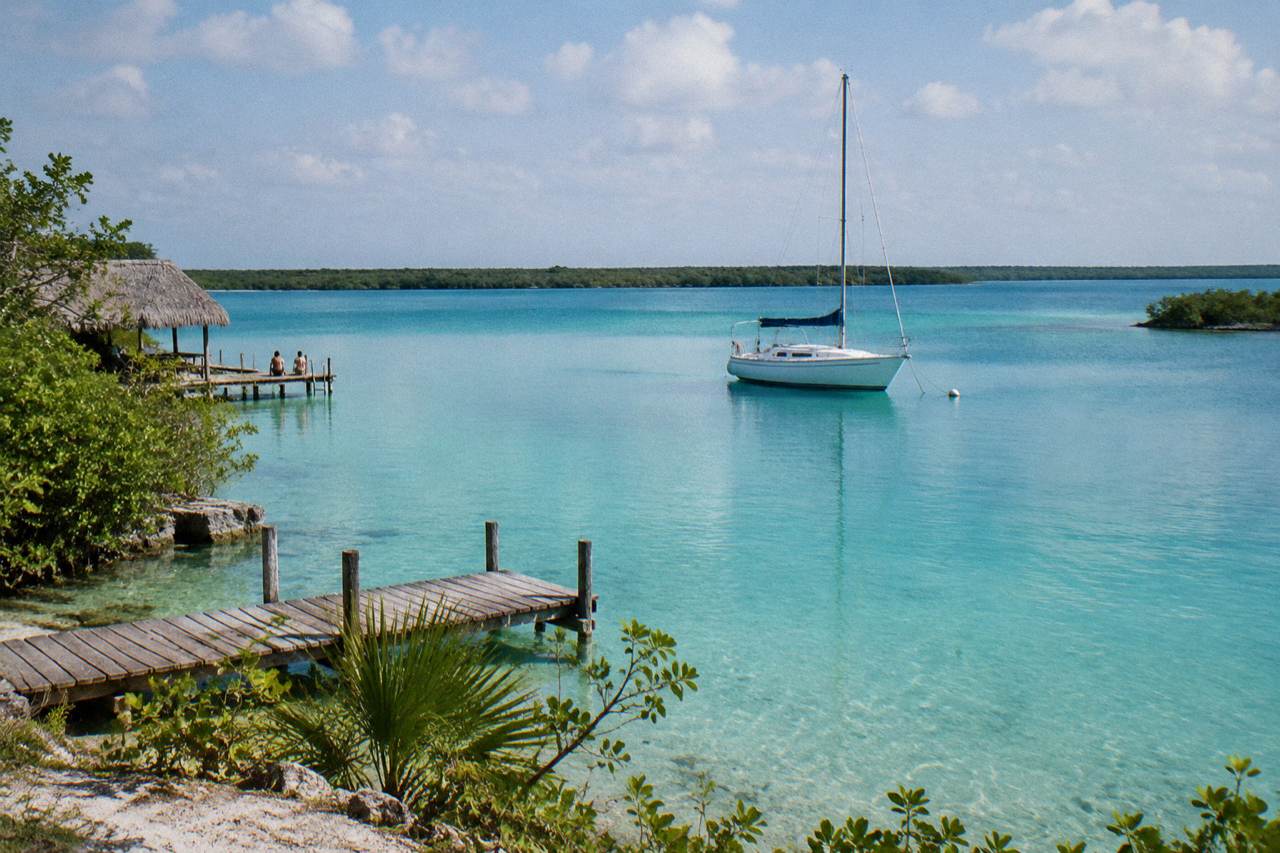
Yes, people swim at Los Rapidos, the shallow channel that links Bacalar with the Xul Ha lagoon, but not on the microbialites themselves. The channel's visible formations are exactly why the port authority restricts navigation there, buoyed zones stay off-limits, and swimmers float in the current alongside the structures rather than walking or standing on them.
Los Rapidos is the gentle current that visitors love, a natural lazy-river float over a white rock bed, with dark microbialite rims along the channel. It is also the most damaged-by-love spot on the lagoon, because the temptation to stand on or grab the formations is highest where the water is shallowest. The port authority's zoning makes the point formally: Zone 5 covers Los Rapidos and the channel connecting the Bacalar and Xul Ha lagoons, and navigation is restricted for motor and sailboats there. In the Canal de los Piratas, motor vessels need authorization from the Port Captaincy. Sensitive areas marked with buoys are completely off-limits: no vessels and no swimmers.
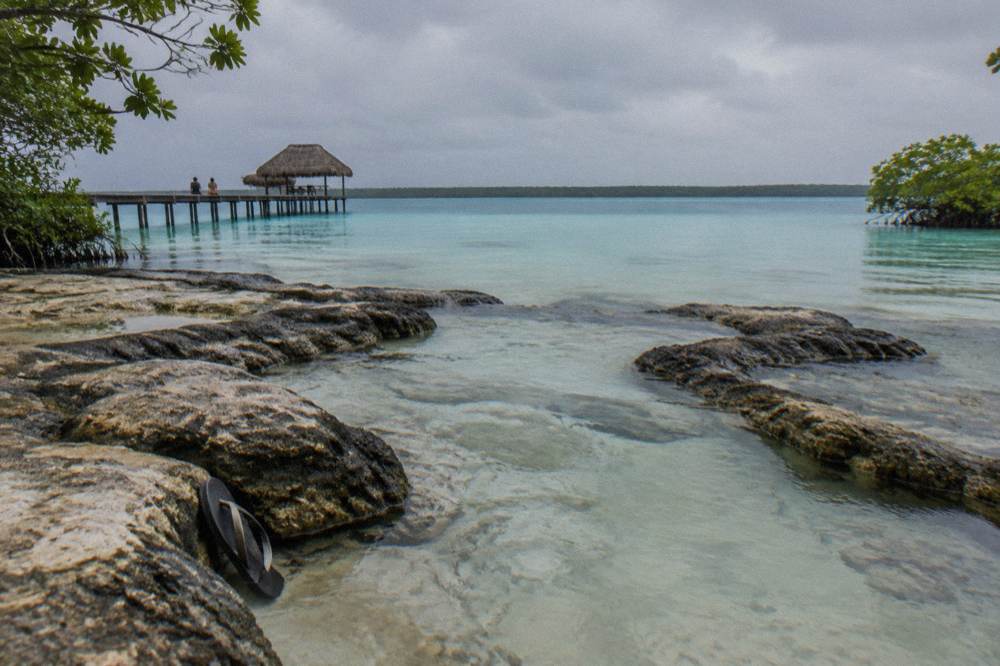
Entry to the site is paid at the gate and varies by site; the tour listing states what is included. What you do there is float. The current carries you, the formations stay below and beside you, and the etiquette is simple: no standing on the dark structures, no sunscreen in the water, reef-safe included, and UV clothing instead. Our Los Rapidos guide covers the practical side of a visit, and our swim safety explainer answers the safety questions that usually follow.
| Zone | What the port authority's zoning says |
|---|---|
| Zone 1, shoreline to 50 m | Caution area, maximum 7.4 km/h, for swimmers and small boats |
| Zone 2 | All vessels, maximum 18.52 km/h |
| Zone 5, Los Rapidos and channel | Navigation restricted for motor and sailboats |
| Zone 5, Canal de los Piratas | Motor vessels only with Port Captaincy authorization |
| Buoyed sensitive areas | Fully off-limits to vessels and swimmers |
A note on wording, because it matters: these are the port authority's announced zoning measures, not federal law. The agreement naming the Port Captaincy as the applying authority was still unpublished in the official federal gazette as of late 2025, per reporting on the socialization process. Treat the zones as real and enforced on the water, which they are, without calling them statutes.
What Actually Threatens The Microbialites: Sunscreen Or Sediment?
Research reported in 2026 points to sedimentation and nutrient inputs, not direct visitor contact alone, as the greater risks to Bacalar's microbialites, though touching and anchoring still cause local damage. A 2025 water-quality study found the lagoon's central basin oligotrophic and the northern basin mesotrophic, with an increasing eutrophication trend across the region's lakes.
The answer is layered. Visitor contact damages formations one handprint or anchor at a time, and the municipal rules target that directly. But the researcher who corrected the stromatolite naming, Maria Luisa Villarreal, argued in the same reporting that sedimentation from construction and land use, and nutrients entering the water, are the larger threats, per Riviera Maya News's report on her findings. No confirmed widespread bleaching or die-off of the microbialites appears in the 2025 and 2026 reporting reviewed.
The water-quality picture supports that concern. A December 2025 study in the MDPI Hydrology journal, Trends in Surface Water Quality and Trophic State in the Yucatan Peninsula over the Last Decade, classified Bacalar Centro and Sur as oligotrophic, meaning nutrient-poor, while Bacalar Norte came out mesotrophic, indicating higher nutrient input in the northern basin. The study also documented a short-term brownification event in 2020, linked to intense rainfall and nutrient inputs, from which the lagoon's colors later recovered. The lesson for a visitor is that the sunscreen ban is not bureaucratic fussiness: nutrients are the documented enemy of the lagoon's color, and sunscreen is a nutrient source every swimmer carries.

How Do You Pick A Bacalar Tour That Respects The Rules?
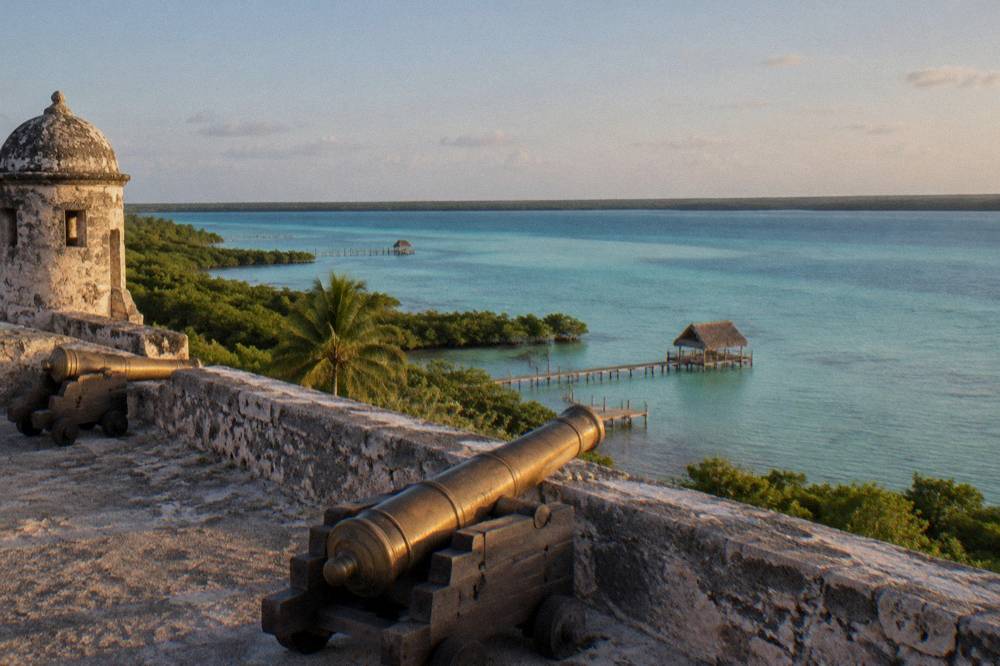
Pick an operator that keeps swimmers out of the buoyed zones, holds at distance from the formations, and states its route and inclusions clearly on its listing. On this site, sail and paddle formats carry the smallest footprint, and every listing below states exactly what it includes, from drinks and snacks to safety gear, so you can judge the operation before you book.
The rule shapes how a tour operates, which informs which operator to trust. Signs of a well-run trip: the guide names the 3-meter rule unprompted, the boat anchors in open water away from the buoys, swimmers are pointed at sand or open areas rather than the dark domes, and the crew repeats the sunscreen ban before anyone gets in. A captain who shrugs at any of those is a captain to walk away from, especially given that the port authority has warned of fines from 6,000 up to 1 million pesos for vessels operating irregularly on the lagoon.
The sailing format is a natural fit for the shallow margins. The Sailing Tour through the Laguna de los Siete Colores, from $45 per person and 5.0 from 1,670 reviews, runs 3 hours from the Casa Arabe pier with a maximum of 30 travelers, seasonal fruit, bottled water and beer included, and a sail-only silhouette that suits the protected edges of the lagoon.
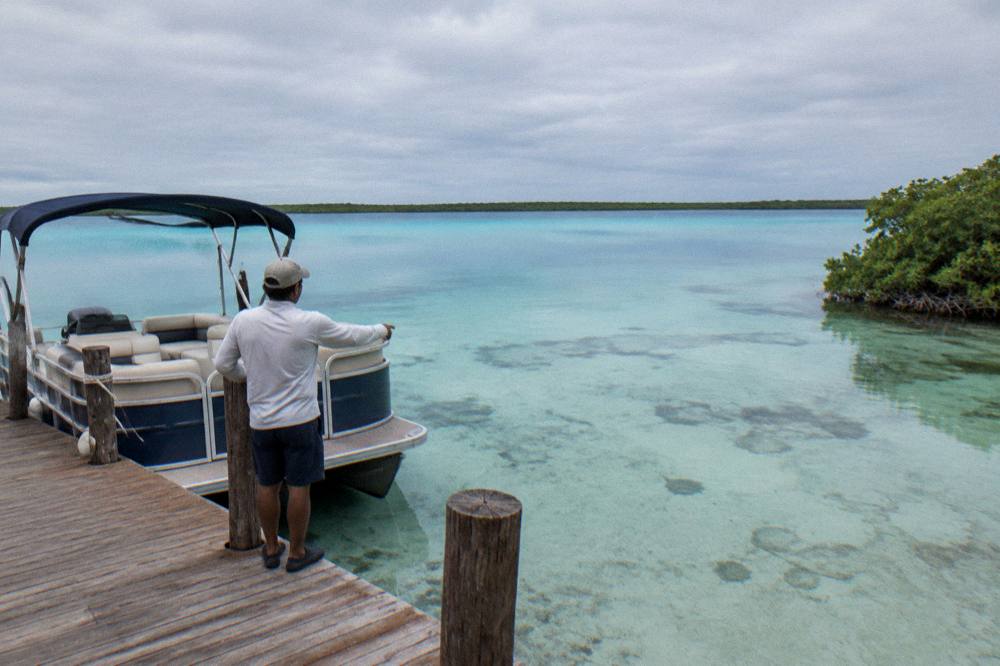
For a group or family circuit, the pontoon format keeps everyone in deeper water between swim stops. The Pontoon Tour covering the Pirate Channel, cenotes and islands, from $32 per person, 4.9 from 432 reviews, runs 2 hours 30 minutes with beer for those over 18, bottled water and seasonal fruit, capped at 22 travelers.
At the budget end, the Bacalar: Lake of Seven Colors Pontoon Tour, from $25 per person and 5.0 from 275 reviews, covers the same 2 hours 30 minutes circuit with water, seasonal fruit and a cooler with ice, with gratuities listed separately. Price alone says nothing about how a crew treats the formations, so the questions above still apply, and the cheapest boat is fine when the guide runs the same route with the same discipline.
| Listing | Format | Price | Rating |
|---|---|---|---|
| Boat Tour and Visit to Cenotes (DayTour Bacalar) | Boat, 3 hours | from $29 per person | 4.9 from 1,321 reviews |
| Sailing Tour, Laguna de los Siete Colores (Wild Wave) | Sail, 3 hours | from $45 per person | 5.0 from 1,670 reviews |
| Pontoon, Pirate Channel and Cenotes (Wild Wave) | Pontoon, 2 hours 30 minutes | from $32 per person | 4.9 from 432 reviews |
| Lake of Seven Colors Pontoon (Laguna Adventures) | Pontoon, 2 hours 30 minutes | from $25 per person | 5.0 from 275 reviews |
What Should You Remember Before You Get In The Water?
Keep 3 meters between you and any dark, rock-like formation, never stand on or touch them, wear UV clothing instead of sunscreen, and follow the buoys, which mark zones that are off-limits to everyone. Swim in open water or sand-bottom areas, and if a crew tells you otherwise, that crew is wrong.
The complete etiquette fits on an index card. Look from at least 3 meters. Never touch, climb, sit on or anchor on the formations. No sunscreen in the lagoon, even biodegradable, so bring a rash guard. No exfoliating with the lake clay, no touching the Chivita snail, no waste, no smoking, no tying up to mangroves. Respect the bird sanctuary areas by keeping noise down. If you want the full packing logic behind the UV clothing and dry bag decisions, our what to bring on a lagoon tour guide covers it.
One more frame for the whole topic. The lagoon runs all year, dry months November to April and rain from roughly June to October, and the microbialites are there in every season. In low season there is no boating on Wednesdays, while nautical providers clean the lagoon, resuming regular boating around Holy Week; a proposal to move the rest day has been reported without a confirmed outcome, so check the listing for the day's schedule. There is no closed season for the formations, only open water and rules that keep them alive.
Bacalar's microbialites are the quiet reason the lagoon has rules at all, and they reward the visitor who slows down. Look long from the deck of a sailboat at first light, float the current at Los Rapidos without a footprint on the dark domes, and the lagoon gives back the exact view that made it famous.
Common Questions About Bacalar Stromatolites
Are Bacalar's Stromatolites Actually Stromatolites?
Not strictly. Researchers classify them as microbialites, a related but distinct formation built by microbial colonies. The visitor word stromatolites is used locally and on tour descriptions, but the strict term is microbialites.
How Close Can You Get To The Stromatolites In Bacalar Lagoon?
The municipal ecology guide asks visitors to look from at least 3 meters away and never touch, climb, sit on or anchor on the formations. Buoyed sensitive zones are completely off-limits to vessels and swimmers.
Can You See Stromatolites On A Bacalar Boat Tour?
Yes, most tours pass them near the Canal de los Piratas, around the lagoon's cenotes and along the shallow margins, holding at a distance. Listings describe their own routes, and sail, pontoon and paddle formats all pass the formations.
Why Is Sunscreen Banned In Bacalar Lagoon?
The municipal ecology guide bans sunscreen for swimming in the lagoon, even biodegradable formulas, because it adds nutrients that accelerate eutrophication, one of the documented causes of the lagoon changing color. UV clothing is the recommended alternative.
Are The Stromatolites Dying?
No widespread die-off was confirmed in the 2025 and 2026 reporting reviewed. Researchers point to sedimentation and nutrient inputs as the larger threats, while a 2025 study found the central and southern basins nutrient-poor and the northern basin showing higher nutrient input.